
INTERFLOW in Practice
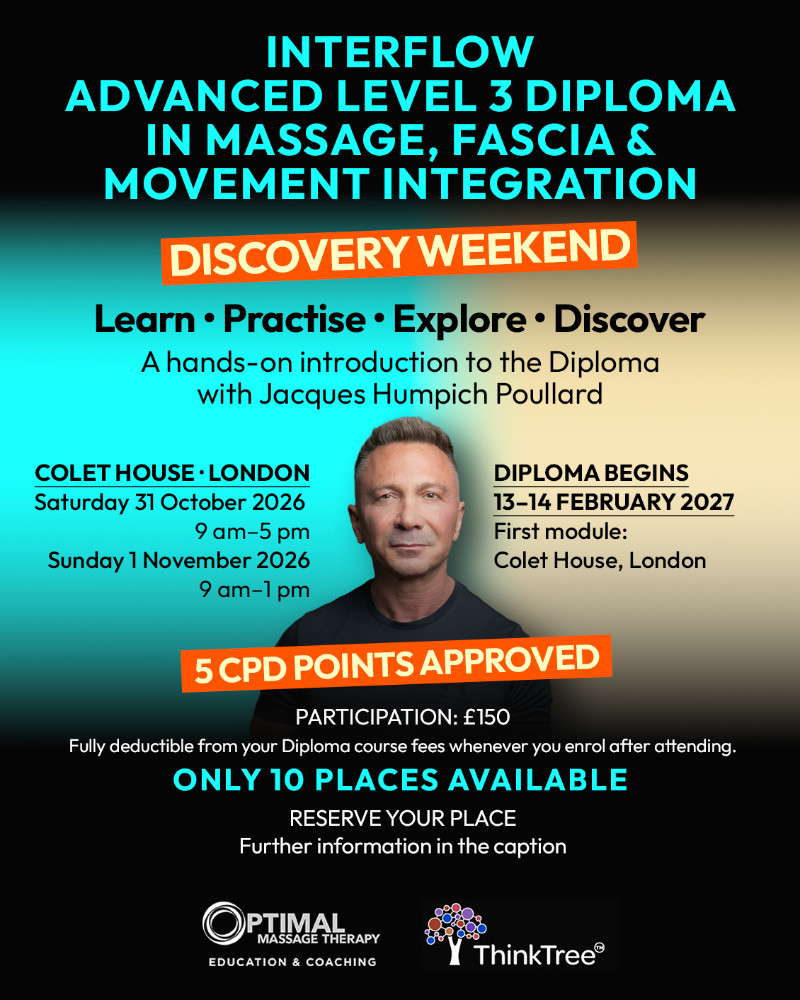
A Hands-On Discovery Weekend
A Day and a half exploring the approach behind the Advanced Level 3 Diploma in Massage, Fascia & Movement Integration.
West — Sports & Manual Therapy | East — Yoga & Thai Massage
Anatomy • Bio-Tensegrity • Breath • Sensory Movement • Advanced Massage Practice
Discovery Weekend | Colet House, London | 31 October–1 November 2026
Saturday 31 October: 9 am–5 pm | Sunday 1 November: 9 am–1 pm
Taught by Jacques Humpich Poullard
5 CPD Points approved | Only 10 places available
Workshop Fee: £150
Fully deductible from your Diploma course fees whenever you enrol after attending.
Reserve a place: Contact Jacques directly via WhatsApp on 07875941847 to register and receive a payment link.
Advanced Level 3 Diploma begins: 13–14 February 2027
First module and Diploma course venue: Colet House, London.
Colet House, 151 Talgarth Rd, London W14 9DA

Interflow is an integrated approach to massage and bodywork developed by Jacques Humpich Poullard through more than twenty years of practice and study. It brings together sports, remedial and deep tissue massage, myofascial approaches, facilitated movement, yoga-inspired movement and bodywork, and Thai massage.
At its centre is fascial integration: an approach to practice that considers how local tissues participate within the body’s wider relationships of movement, tension and support.
Massage provides the hands-on foundation. Anatomical knowledge gives precision to the work. Breath, sensory awareness and movement guide its development. Responsive Myofascial Adaptation—RMA—connects these elements through ongoing observation and adjustment.
The hands remain essential. Through them, the practitioner explores, supports and applies skilled contact. They become the expression of the practitioner as a whole: anatomical understanding, perception, posture, movement and professional judgement meet at the point of touch.
Fascial anatomy as a way of understanding the body
Within Interflow, “fascial anatomy” describes an anatomical perspective centred on continuity and relationships.
Conventional anatomy provides indispensable knowledge of individual structures—their attachments, actions, innervation and particular characteristics. Fascial anatomy extends that attention to the connective tissues within and between them, and to how these relationships accommodate movement and loading.
This perspective has practical consequences. When working around a shoulder, for example, the therapist considers the local tissues alongside the position of the arm, the participation of the thorax and the support beneath the body. Anatomical specificity and a wider view of movement inform the same contact.
Dr Jean-Claude Guimberteau’s observations of living connective tissue offer a compelling view of this architecture: interconnected arrangements that accommodate deformation and sliding while maintaining continuity. They support an understanding of anatomy as living structure in movement. [1]
Myofascial maps can help organise this exploration. Within Interflow, they serve as guides to observation and reasoning, with each person’s anatomy, comfort and movement informing their application.
What fascial integration means in practice
Fascial integration describes how the practitioner connects local manual work with positioning, movement, support and the person’s response. It is a principle for organising treatment, rather than a claim that a particular structural change has occurred.
A region can be approached directly while remaining part of a wider movement. A change in support can alter the conditions beneath the hands. A movement can reveal where greater precision, a different direction or a pause may be useful.
The practitioner therefore attends to both the site of contact and the relationships around it.
This makes integration an ongoing process. The therapist continually considers how pressure, direction, pace and positioning work together, and how the person experiences their combination.
The aim is to develop a coherent session in which local work contributes to comfort, body awareness and accessible movement, with these outcomes revisited through feedback and reassessment.
West and East as complementary foundations
The Western contribution brings anatomical reasoning, focused soft-tissue work and systematic reassessment through sports and manual therapy.
The repertoire includes deep tissue massage, myofascial release, Soft-Tissue Release (STR), Connective Tissue Release (CTR), Neuromuscular Technique (NMT) and suitable forms of Muscle Energy Technique (MET). Their application reflects the person’s priorities, the region being approached and the response to the work.
Thai massage and yoga contribute supported movement, adaptable positioning, rhythm and embodied awareness. Forward bends, twists, side bends and hip-opening movements create different settings for hands-on practice.
Within Interflow, these influences are brought into the same process. Massage may take place during a supported movement or within an adapted yoga-inspired position. A manual contact may inform the next movement; that movement may then suggest a change in contact.
The integration lies in how the practitioner connects these choices. Each technique retains its value while contributing to a session that develops with the individual.
Myofascial release within a responsive approach
Myofascial release has an important place within Interflow’s repertoire. Contact may be sustained, directional or accompanied by movement, according to the approach being used and the person’s response.
A perceived change in resistance, comfort or movement provides useful information. Interflow carries that information forward: how does the region respond in a different position? Does movement feel easier? Does the change remain useful when support is altered?
The term “release” describes an experience or observation within this process. On its own, it does not establish that an adhesion has been broken, fibres permanently realigned or a particular tissue mechanism identified.
Some myofascial release approaches already include movement, listening and responsive adjustment. Interflow builds on this shared territory through an explicit framework that connects manual contact with the wider organisation of the session.
Responsive Myofascial Adaptation
Responsive Myofascial Adaptation—RMA—is Interflow’s signature organising principle.
It describes a process in which massage, facilitated movement, breath and support evolve together, with each adjustment informed by the person’s response.
RMA provides a clear identity for the reasoning that connects the work. The practitioner establishes a reference, introduces manageable input, observes and listens, then adjusts and reassesses.
Resistance becomes information to interpret in context. It may involve tissue mechanics, muscular stabilisation, discomfort or several influences together. The therapist responds by reconsidering direction, pressure, range, leverage, rhythm or support.
For example, while supporting a leg, the practitioner attends to the local tissues alongside pelvic movement, breathing and contact with the table. An increase in resistance may lead to a smaller movement, a different angle or more support. Massage continues within the conditions that prove appropriate.
The response helps determine the next decision.
RMA’s proposed innovation lies in making this synthesis explicit, coherent and teachable across techniques. It names a practical method of integration; it does not claim the discovery of a new biological mechanism.
Living tissue and the research perspective
Interflow’s fascial philosophy includes mechanical behaviour, local cellular responsiveness and nervous-system influences.
Experimental work by Hélène Langevin and colleagues showed that fibroblasts in mouse connective tissue remodelled their internal structure in response to stretch and contributed to tissue tension. This supports recognition of connective tissue as biologically responsive, alongside its material properties. [2]
Research by Robert Schleip and colleagues identified myofibroblasts in human fascial samples and measured contraction in chemically stimulated, isolated rat fascia. These findings demonstrate contractile capacity under the conditions studied. [3]
These studies inform the method’s understanding of living tissue. They do not establish which mechanism causes a change perceived during massage or validate Interflow as a complete treatment approach.
This distinction strengthens the practice: professional experience guides skilled observation, research informs interpretation, and the person’s feedback helps establish what is useful. Immediate changes in sensation or movement remain distinct from longer-term tissue adaptation.
Bio-tensegrity and the conditions for movement
Bio-tensegrity provides a model for exploring relationships between tension, compression and support. Within Interflow, it complements anatomical knowledge and conventional biomechanics.
On a table or mat, the person remains subject to gravity. Contact with the supporting surface and the therapist’s handling influence how body weight is supported. Moving a limb or changing position alters these relationships.
Interflow brings this mechanical setting into the therapist’s awareness. The practitioner considers where stability is provided, where movement is available and how a change in support influences the area being approached.
Support becomes an active part of the method. Its adjustment can be as relevant to the next step as a change in manual technique.
Breath and sensory movement
Breath provides an ongoing point of connection between movement, contact and the person’s experience.
The practitioner observes respiratory movement and invites breath awareness when useful, allowing the person’s natural rhythm to guide participation. Changes in breathing are considered alongside comfort, guarding and verbal feedback.
Sensory movement develops attention to how movement is experienced. Range matters, but so do ease, coordination, confidence and the ability to participate comfortably.
Movement progresses through gradual adjustments. The person may receive supported movement, contribute gentle active effort or alternate between both. Yoga-inspired positioning provides adaptable possibilities for this exploration.
The emphasis is on finding movement that is available and meaningful for the individual.
The hands as an expression of the whole practitioner
The hands are central to Interflow’s precision and responsiveness. Their contact is shaped by the practitioner’s stance, balance, body weight, breathing, attention and movement.
The whole practitioner participates in the quality of touch.
A change in stance can alter the direction of pressure. A shift in body weight can support a smoother transition. Coordinating the arms with the trunk and legs can reduce reliance on isolated muscular effort.
Practitioner awareness therefore belongs within the method itself. It concerns how force is offered, how support is maintained and how clearly the therapist can perceive and respond while working.
Anatomical knowledge gives intention to contact. Sensory attention helps refine it. Whole-body organisation supports its delivery. The hands bring these capacities together in a precise, adaptable interaction.
Discovering Interflow through practice
The discovery weekend introduces professional massage therapists and bodywork practitioners to this integrated framework through demonstration, guided hands-on practice, observation and shared reflection.
Participants will explore how fascial anatomy, myofascial approaches, gravity, breath and yoga-inspired movement inform one another—and how their own organisation contributes to the work.
The weekend offers a practical introduction to the thinking developed further within the Interflow Advanced Level 3 Diploma, connecting new perspectives with the experience participants already bring.
At the heart of the approach is a guiding principle:
“Create the conditions in which the next movement can become available.”
Interflow makes this a practical enquiry pursued through skilled massage, informed observation and the responsive participation of the whole practitioner.
Research references
[1] Guimberteau JC, Delage JP, Wong J (2010). Faire peau neuve [New views about the skin]. Annales de chirurgie plastique et esthétique, 55(4), 255–266. https://doi.org/10.1016/j.anplas.2009.11.009
[2] Langevin HM et al. (2011). Fibroblast cytoskeletal remodeling contributes to connective tissue tension. Journal of Cellular Physiology, 226(5), 1166–1175. https://doi.org/10.1002/jcp.22442
[3] Schleip R et al. (2019). Fascia Is Able to Actively Contract and May Thereby Influence Musculoskeletal Dynamics: A Histochemical and Mechanographic Investigation. Frontiers in Physiology, 10, 336. https://doi.org/10.3389/fphys.2019.00336